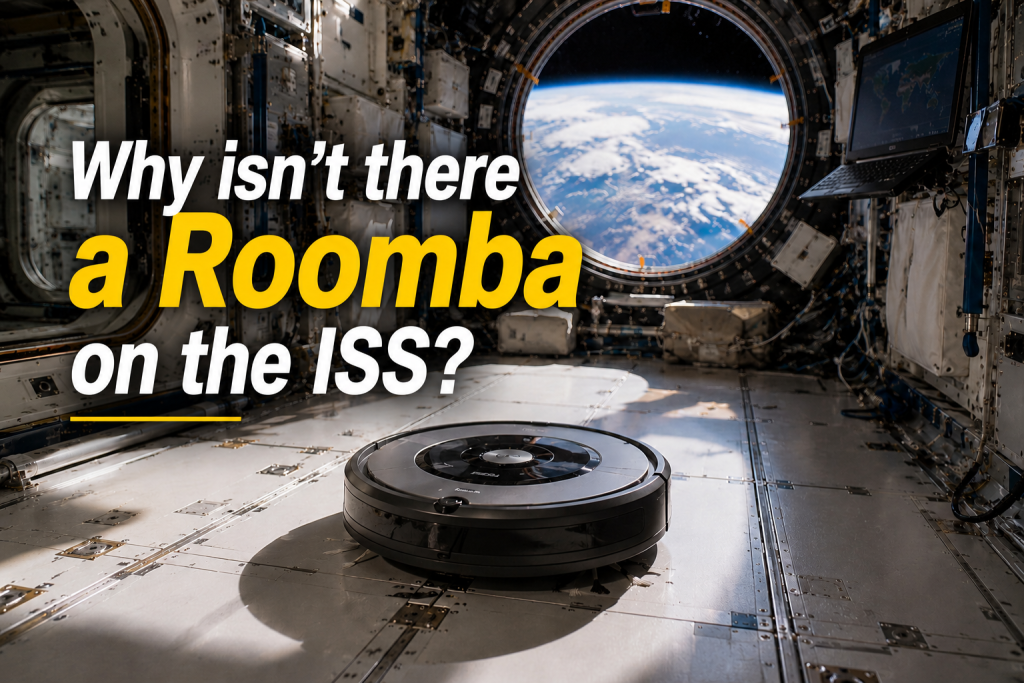
Why Isn’t There a Roomba on the Space Station?
Humanoid robots are becoming one of the most discussed technologies in robotics.
Most of the conversation, however, is about factories, warehouses, and homes.
There is much less discussion about where humanoid robots could potentially create far greater value: space.
Why Space Could Be Different
On Earth, a humanoid robot is primarily competing with human labor.
A factory robot can save time, reduce labor costs, and improve productivity. Those are significant benefits.
But on the Moon or in a space station, the equation is very different.
Every human task in space comes with additional costs, risks, training requirements, and logistical constraints. A robot that can perform those tasks could provide value far beyond simply replacing a worker.
Imagine a future lunar base with six humanoid robots.
One robot breaks down.
Instead of waiting for humans to travel to the Moon, the other five robots could potentially inspect the damaged robot, identify the problem, retrieve the required component, and help repair it.
The robots could become a self-supporting workforce.
That changes the economics of robotics completely.
The Bigger Question
This leads to a surprisingly simple question.
We have had robotic vacuum cleaners such as Roomba in homes for years.
So why isn’t there a Roomba on the International Space Station?
It sounds almost trivial.
But perhaps the question reveals something important about how we think about technology.
We tend to ask whether a technology can replace human labor.
Perhaps in space, the better question is:
Can robots allow humans to do things that would otherwise be impossible, unsafe, or prohibitively expensive?
That is a much bigger opportunity.
The future of robotics may not simply be about building robots that work for us.
It may be about building robots that go where we cannot.
#Robotics #SpaceExploration #AI